
We are always looking for new, unique and rare foods from farmer who’s practices celebrate the land and foods they produce. We came across an amazing dried apricot that was unlike any we had before. The skin was thin and delicate leaving the fruit juicy, sticky and tender. The Blenheim apricot, named after England’s Blenheim Place where it is thought to have originated, has been grown in the Santa Clara Valley region of California since the early 1900’s. At the height of its popularity it was one of the most widely planted apricot varieties for good reason. The Blenheim ripens from the inside out and later in the season, making it more delicate than most. The Blenheim is both sweet and tart with an intensely aromatic aroma of honeysuckle.

The development of modern sheep traces back to ancient Mesopotamia where the wild muflon, the ancestor of modern sheep, were first believed to be domesticated between 11000 and 9000 BC. These sheep were primarily raised for meat, milk, and skins. Woolly sheep began to be developed around 6000 BC in Iran, and cultures such as the Persians became dependent on sheep’s wool for trading. Domesticated woolly sheep were imported to Africa and Europe via ancient trading routes where breed distinction and differentiation began to take shape.
Christopher Nicolson, of Iliamna Fish Co., was raised in a fishing community just like generations of his family before him. Fishing knowledge and connection to the local Kenai Peninsula of Bristol Bay, Alaska is part of Christopher’s heritage and his way of life. Lucky for us, Christopher is a neighbor and good friend of Heritage.
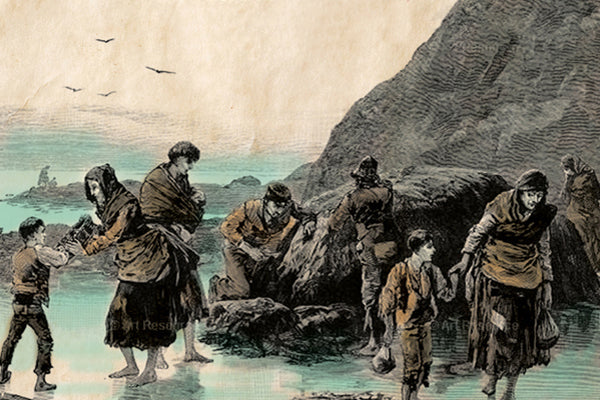
The history of Irish food is interesting for more than just the delicious combinations of meat, potatoes and alcohol but also for the lessons we must learn from the great tragedy of the Irish Potato Famine. Between 1845 and 1852 over one million Irish peasants died of starvation and another million fled the country hoping for fuller bellies. While there were many political and social factors leading to the terrible scale of this tragedy, everything started with nearly 3 million Irish peasants subsisting on a single strain of plant in their fields, one variety of the potato. This great tragedy hits close to home here at Heritage Foods USA as we support farmers fighting against the pressure of moving toward a monoculture food system.
St. Patrick’s Day brings memories of bagpipes marching down 5th Avenue in New York City, dying the river green in Chicago or a stomach too full of Guinness. Rarely, however, is a delicious meal associated with the once religious holiday. This may be because, as one writer put it, “economy is the main ingredient in most traditional Irish dishes.” The culinary tradition of that came out of a largely peasant Ireland to a proud Irish-American community is one of humble, simple and truly delicious food. St. Patrick’s day gives us the opportunity to tell the story of the food of Ireland taking us from the Gaelic Kings, through the Great Famine, to the now prosperous and proud Irish-Americans.

Don’t have a machine slicer at home? Not to worry, hand slicing is a can be a difficult skill to master but in reinforces the ancient roots of cured meat. It creates a unique experience compared to the machine generated paper thin slices and allows you to appreciate three-generations of curemaster knowledge that produce the perfect Surryano.
We first heard of St John’s Bread and Life (B&L) when Anthony Butler, the Executive Director, approached us about participating in one of their events providing food for New Yorkers in need. We were surprised to learn that B&L is the largest organization in Brooklyn working to end hunger in our community. Each and everyday Bread and Life supplies thousands of meals to people and families in need. But it wasn’t until we visited their facility on Lexington Avenue in Bed-Stuy, Brooklyn that we really fell in love with their mission.
© 2026, Heritage Foods Powered by Shopify
